 Hadar Bismut
On 16.10.2026 Anthropic published a report (opens in a new tab) on how the job market is changing, with a focus on how it's happening inside their own company. There are interesting numbers and data in it, but also quite a lot of focus on people, which of course is what interests me most.
The report draws on the company's internal data (opens in a new tab) on employment, AI use, productivity, employee surveys, internal communication, calendars and hiring decisions, and the researchers also interviewed 17 employees to understand how their work has changed.
Here are a few things that caught my eye and might interest you too, but first, 2 notes:
Note 1: The very fact that a company like Anthropic puts out a report on the world of work and employment says a lot about how well they understand that what they're building, the product itself, is changing the rules of the game. I'd like to say they're taking responsibility and understand that they're changing the language and the job market, but I'm really not sure. Maybe this is another classic case of greenwash (sweet transparency that turns out to be manipulation in the end), but for our purposes here, let's just try to learn from what they publish and forget the rest, because there's no doubt there's a lot to learn from them.
Note 2: Anthropic is an AI-native company, which means processes are much easier for them to adopt in the world of AI. A "regular" organization will take a long time, depending on its size, to get to where they are and be affected by the same things.
First conclusion: agents work more hours than people
In the report, Anthropic say that this past August (opens in a new tab) they reached a point where the company's agents were putting in 6 times the working hours of its people. In other words, every hour an employee worked was already worth 6 hours of work by agents they ran themselves.
At the same time, they stress that people remained critical, and all that changed is the kind of impact they have. The way we work is changing, but people matter just as much. I'll explain more further on.
Second conclusion: everyone can (and must) be a Builder
According to the report, among employees who didn't write code (like designers, PMs or salespeople), the number of sessions with coding agents jumped from 2 a month in August 2025 to 90 in May 2026 (opens in a new tab), and the report gives a few examples of what they built:
- A salesperson (opens in a new tab) built a dashboard and pipeline tailored to their own work. It took them about 3 to 4 hours.
- A finance manager (opens in a new tab) built an agent that reviews purchase requests, so people could free up time for other things.
- A lawyer (opens in a new tab) built automations that scan for risks and opportunities and triage legal questions.
- A recruiter (opens in a new tab) used Claude to free up time, and with that time redesigned outdated interview questions and met with more candidates.
- In the technical teams, the number of commits from managers doubled (opens in a new tab).
The Product Design team, which wrote content that appears on Claude's site (for example "Hello night owl" or "Coffee and Claude time?"), built a context graph (opens in a new tab) that guides agents to write better product content. And if you're asking yourself what's left for a content creator to do, the team moved on to writing evals and prompts for Claude. This is how the report puts it: "Writers who used language to drive human behavior are now using it to drive Claude behavior."
These examples are critical for everyone who works in an organization, and for everyone in general in this era: it doesn't matter what your role is or what you're supposed to know or not... it's your responsibility and mine to learn how to work with AI, and to connect it to our profession, to our day-to-day work, and to the way we work.
Third conclusion: the bottleneck is shifting, and the fight is over our attention
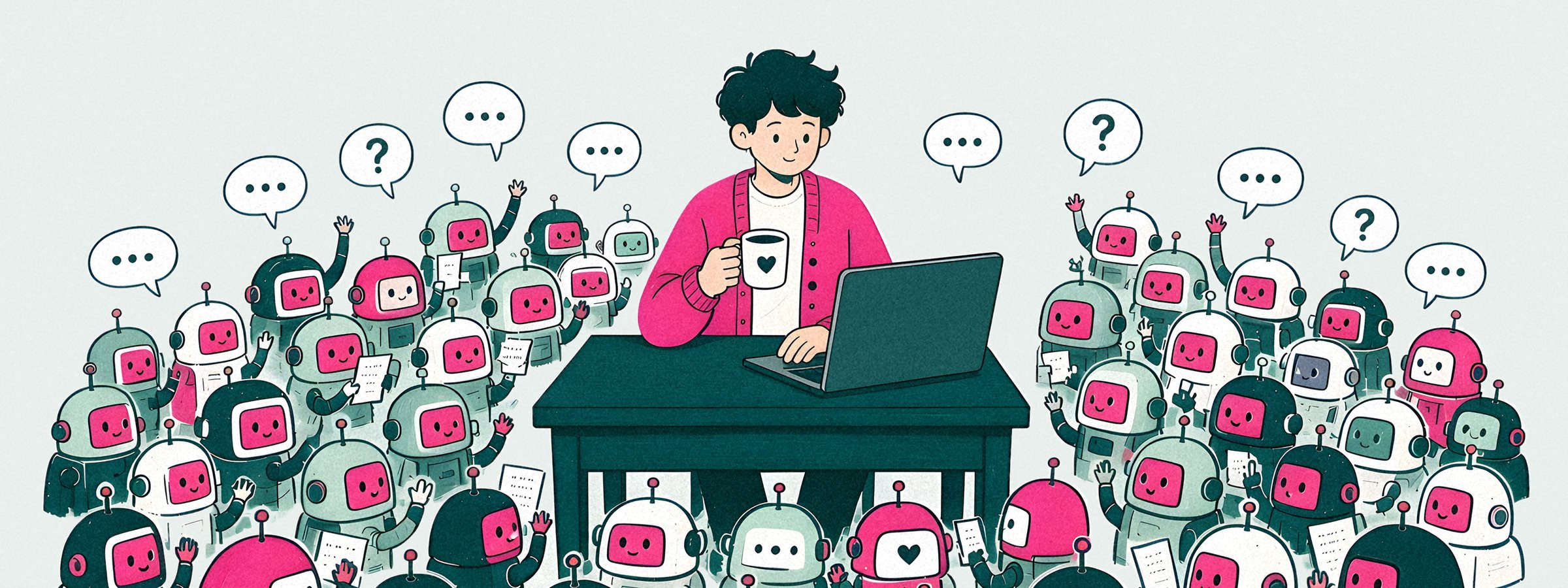
When there are so many agents, the bottleneck becomes people's attention. They're the ones who decide how high-quality the outputs are, how well they meet professional standards, and whether they can move on to the next thing. According to the report, in interactive sessions (opens in a new tab) the agent waits for the human about 80% of the time, and one of the engineers described it (opens in a new tab) as facing "an army of Claudes, with every one asking for my attention." Even for non-technical employees, reading everything their agents produce would take half a work week (opens in a new tab). Personally, I spend a huge number of hours just approving outputs, coordinating their projects and getting into the small details to make sure they're not doing anything stupid. It's not easy at all.
This is where you need to know a new term, meta-work: building skills for Claude, writing plans and reviews for other agents, building dashboards that monitor the agents, and documenting how the work gets done. Employees are starting to invest in all of these, which are really the work around the work. This share rose from 10% of the average employee's sessions in fall 2025 to 22% in spring 2026 (opens in a new tab), and the standing instructions written for agents (opens in a new tab) grew from a few hundred in July 2025 to 8,500 a year later.
And beyond attention, let's talk about the fact that roles are blurring (meaning a product person can build screens, a designer can submit a PR, and so on).
At the last guilds meetup I organized together with HoneyBook, I gave a talk (opens in a new tab) about how guilds help roles blur and let everyone touch the worlds of other professions. That's one of the reasons it's important to go deep into the specific professional knowledge of each field, but above all to understand how to prevent the bottleneck that forms between the different professions.
The report talks about people's attention, and I want to go one step further: being able to submit a PR doesn't mean you know how to do it right. That can lead to real production problems. So right now, what happens in most organizations is that the review is done by the relevant professionals and the high standards they set, which means the attention ends up falling on the "original" professional. If the designer touched something related to frontend, frontend will have to approve it, and if frontend touches the mobile world, mobile will have to approve it, and those are exactly the bottlenecks. That's why each of them needs to figure out how to make their profession one that needs as little human approval as possible, and that requires deepening the standards, not the opposite.
This is where the guild comes in
A guild has always been the professional home, the place where a profession defines itself: the tools we work with, what a good workflow looks like, and the standard that holds us together. A guild used to have one audience, the professionals, and today it has another one: the agents working with them. But if everyone has their own agent, sometimes even several, and they're the one deciding what the standards are, you end up with different standards, outputs of different quality, and lots of agents doing whatever their operator tells them to do. Instead, a guild lets all of this connect and creates a shared organizational standard.
In the talk (opens in a new tab) I showed that when guilds start working, they build the AI context layer for each discipline separately, and the next step is getting that knowledge to work for the other disciplines too, and that's how you shrink the bottleneck between professions.
When we build, for example, design standards, all the rules, all the assets and the brand book, and we make them well, it'll be easier for frontend people to work with design (these examples are of course very superficial, just to get the principle across). And when we build the rules for frontend and run the training needed so people feel confident, we get the other side: design that can touch frontend-related things.
The especially painful point: juniors
According to the report (opens in a new tab), since early 2025 the share of juniors in technical departments dropped from 21% to 14%. Among new hires for technical roles the drop is even sharper, and the share of juniors out of everyone hired for those roles fell from 27% to 9%.
What companies look for when hiring is changing too, and the clearest change is the emphasis on creative use of AI tools. In 2024 (opens in a new tab) interviewers mentioned candidates' experience with AI tools in about 5% of assessments for technical roles and about 7% for non-technical roles, and by 2026 that rate had tripled for technical roles and quadrupled for non-technical roles. In technical roles, the biggest increase (opens in a new tab) was in comments on autonomy and judgment.
According to the report, Anthropic are already taking a few steps to deal with how roles are changing:
- A system that flags and tracks roles (opens in a new tab) that are changing because of AI, so people can be moved in time to roles that fit their skills and are at less risk.
- A preference for internal mobility: when a role changes, the company prefers to move the employee to another role inside the company. In 2026 (opens in a new tab), an employee who had been at the company for at least a year was 50% more likely to move departments in a given month than in 2025.
- Rewarding through stock: many of the employees (opens in a new tab) hold company stock, so when the company succeeds thanks to the change, they benefit from it too. The authors explain that employees teach the agents their expertise and see their work routines change all the time, and they don't do it for free. In their view, it's hard to imagine AI adoption that's good for workers without them having a financial stake in its success.
The report itself says honestly (opens in a new tab) that none of these steps directly solves the drop in junior hiring, and that protecting existing employees doesn't help those who weren't hired in the first place.
The report also notes (opens in a new tab) that in some roles, employees are moving away from the day-to-day work that built their skills in the first place, and in my eyes that's exactly where juniors learn. If that part moves to agents, we need to build people another way to learn. The report doesn't go into how they plan to do that, and notes that alongside what companies do, there also needs to be government policy around retraining and income support (opens in a new tab).
What I'd take back to the organization
Toward the end of the report (opens in a new tab), one of the company's executives is quoted saying that "a workforce that is anxiously worried is not a workforce doing its best work."
The current period, which feels like whole decades rather than a few years, creates a lot of worry, pressure and a big sense of uncertainty. All of this comes with skills we have to pick up in no time, and a sense of FOMO that only keeps growing.
There's no way for us to get out of this race (if we want to stay in the job market, especially in tech), but we can ask ourselves a few questions.
As an individual:
- How much time do I spend working with AI and getting to know all the tools my organization makes available to me?
- How am I upgrading my workflows with AI?
- What am I doing to tell people about and share the things I do?
And if I'm coming from the organization's side, I'd ask:
- Who writes the standards the agents work by, and are they shared?
- Where do decisions get written down, so that both people and agents can find them?
- What's the path for a junior here to become a Builder?
We have a responsibility. Let's take it.